Staff Operating Support (S.O.S.) Funding Concept
A New Kind of Grant for a New Kind of Crisis...and Beyond
What is Staff Operating Support?
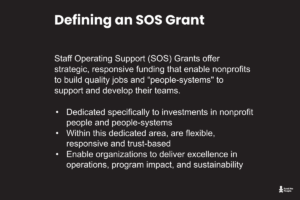
Staff Operating Support (S.O.S.) advances nonprofit effectiveness, impact, and sustainability. It does this by intentionally investing in the workers who make nonprofits work, and by helping organizations develop the policies and practices they need to support their staff team. Here are some of the defining elements of S.O.S. funding:
- 1S.O.S. funding is restricted specifically to investments in nonprofit workers, or to investments in the infrastructure, policies, and practices nonprofits need in order to support their people.
- 2Within the restricted defined above, S.O.S. funding is flexible, responsive, and trust-based. It should be applied in a custom fashion based on context, and its use can be shifted based on evolving need.
- 3S.O.S. funding is a primary grant, not supplementary to general support or project support. This is because the costs of nonprofit people are the largest and most impactful part of nonprofit budgets.
The Problem
Nonprofit workers face chronic underinvestment and burnout, worsened by recent crises.
The Solution
SOS funding incentivizes and empowers nonprofits to build their internal "people systems."
The Goal
To make workforce investment a primary funding strategy, not an afterthought.
Key Insights
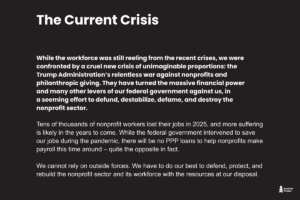
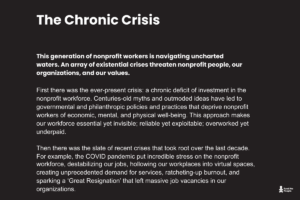
The Crisis
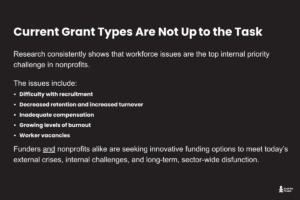
Why Existing Grants Aren't Enough
A New Type of Grant
Drawing on the Best of Existing Grant Types
Recent Articles on S.O.S. Grants
S.O.S.—Nonprofits Need Funding for “Staff Operating Support”
Nonprofit Quarterly
How a Year of Funding Whiplash Reshaped the Nonprofit Work Force
The Chronicle of Philanthropy
Listen to the Podcast
Enjoy Our Premium Content on Patreon!
Frequently Asked Questions
SOS Grants can be used to invest in anyone who make a nonprofit work. We emphasize staff because salaries, benefits, and working conditions are expensive, and chronic under-investment in staff has created real problems.
Does your organization seek to evolve into having staff? If so, you would definitelty benefit from an SOS Grant that can help you create and fill staff positions.
If you want to remain 100% volunteer-run, that’s great too! An SOS Grant could enable you to better support those who provide unpaid labor.
You could use SOS Grants to show your org’s respect and commitment to your small but mighty team! It’ll help you retain them, which is critically important at this scale. You could also use SOS Grants to prepare for growing the team over time!
You could use SOS Grants to learn about your staff’s needs and wants, and begin building an H.R. team, who can develop and maintain people-systems that address the staff’s needs and wants.
You probably won’t get a yes on the first try. But it’s your job as a nonprofit leader to educate funders about your rationale for investing in staff, and how these investments can enhance your org’s effectiveness, impact, and sustainability. Good funders will listen, learn, advocate internally for grantees’ needs, and do what they can to respond. The more often they hear interest from nonprofits in SOS Grants, the more likely they will be to start offering SOS Grants.
It’s your job to educate them and serve as an internal ambassador for the staff of grantee organizations. Remember, there is nothing in the IRS code, Congressional laws, U.S. Constitution, or Declaration of Independence that keeps philanthropic foundations from changing their policies and habits. All it takes is leadership and the political will to change. For examples, listen or read our podcast interviews about how the Ford Foundation, MacArthur Foundation, Annie E. Casey Foundation, and others changed their overhead/indirect cost rates significantly as a result of Real Costs, Real Change Initiative, a shared research and learning experience that is now archived at Funding for Real Change.
Capacity-building is usually supplemental to a primary grant. You often have to be an existing grantee to access capacity-building. SOS Grants aren’t supplemental; they ARE the primary grant.
Capacity-building is often delivered as an external resource (e.g., access to training), or as a one-off, time-limited, project-specific grant (i.e., funds for strategic planning). SOS Grants, however, provide grantees the incentive and ability to build their own people-systems. Specific uses will vary based on context.
Despite It’s hard to prove any grant dollars cause social change. Venture capitalists often lead with dollars focused on building the core team of a business in which they invest; however, this crucial talent-investing practice too often gets overlooked in ‘venture philanthropy,’ which has focused on measuring outcomes, rather than creating the conditions that can lead to them. Carmakers don’t build speed; they build engines that can build speed.
Nonprofits aren’t machines; social change is driven by humans and relationships between them. As a philanthropic investor, your funding can help to build nonprofits with the people power to drive impact. Despite the dearth of funding for research to garner data on the value of talent-investing, there’s a growing amount of evidence nevertheless. There’s evidence in business management literature, such as Dr. Jeffrey Pfeffer’s book The Human Equation, which shows that sustained investments in employees can result in significantly greater profits, customer service, shareholder value, and sustainability of companies. Cite Fund the People’s research, including our 2025 report Long-Haul Grantmaking and our other case studies, which offer stories and quantitative data on results of talentinvestment, as well as our 2023 article in The Foundation Review, The Soft Stuff Doesn’t Have to Be Hard.
SOS Grants are trust-based, flexible, and responsive to the specific, everchanging needs of grantees. When you provide SOS Grants, you don’t need to micro-manage payroll. In fact, SOS Grants demonstrate your high level of dependability as a funder, and demonstrate your trust in grantee organizations, leaders, and teams. SOS Grants can be thought of as a new tool in your trust-based grantmaking approach.