Upgrading
Nonprofit Workplaces
Case Study
#3 of 8
Diversity, Equity, and Inclusion
The Journey Towards Racial Equity:
How investment in DEI rejuvenated the Rising Sun Center
A Lunar New Year celebration. A Dia de Los Muertos celebration. A staff trip to the Oakland Museum of California, which has exhibits on racial equity. These and other cultural events for the Rising Sun Center for Opportunity staff were organized by a voluntary group made up of employees of color, the Black, Indigenous and other People Of Color (BIPOC) Affinity Group.
Forming and supporting such affinity groups is one responsibility of the Diversity, Equity, Inclusion and Justice (DEIJ) Committee, whose members serve two- or three-year terms and are paid stipends on top of their regular salaries. The committee has authority over a budget for events, outside trainers, and other expenses. Since the Committee’s inception, Rising Sun has added racial diversity to the organization’s leadership team.
Staff satisfaction with its DEIJ climate has risen dramatically. When asked in a staff survey about whether Rising Sun is a “diverse, equitable and inclusive workplace,” the share of employees answering affirmative has risen from a low 57% in 2021 to a stellar 97% in 2025. One survey respondent said, "I think our continued commitment and growth in the DEIJ space is amazing, it's such a strong aspect of our culture that makes me proud to work here."

Steven Cong
Rising Sun runs job training and career-building green energy programs in the Bay Area and rural Central California, serving primarily low-income youth of color. Steven Cong, Senior Program Manager for Climate Careers Bay Area, explains how the internal DEIJ work supports their program work: “Even though DEIJ seems niche and focused on identity, the work boosts staff morale. It gives people more to look forward to in their day jobs, which organically boosts productivity. DEIJ helps staff connect our mission to the lives of disadvantaged communities.”
What motivated the DEIJ focus?
First, a compensation equity survey in 2019 found some race and gender disparities. This led to raises, and also to soul-searching about whether and how Rising Sun was a white dominated organization. Turnover was higher among staff of color than white staff.
Rachel Burns
And then came the national racial reckoning in 2020. “I think what prompted a lot of the DEIJ work was… after the murder of George Floyd... making sure we're uplifting and supporting our employees of color, our low income employees, our employees who are facing barriers that might be unique to either the community that they're coming from, or their age,” says Rachel Burns, Associate Director of Human Resources and Administration.
The COVID year of shutdown also put stress on the organization and the staff. The jobs out in the community, disproportionately held by people of color, which involved recruiting and supervising young people in a seasonal summer program, were especially stressful at that time.
Julia Hatton
An earlier effort to deal with staff burnout had been unsuccessful. Executive Director Julia Hatton learned from that experience, and it influenced her approach to the change process that began in 2020. She tells this story of learning from the earlier mistake: “The burnout culture in the youth program was very real… We didn’t have enough staff to run a complex, resource-intensive program. One position required going into the community to sign people up for free energy efficiency services, working evenings and weekends, often being told ‘no’, and making a standard nonprofit salary… often working late and being on-call.” Hatton recounts her regrets at how she handled those stressed-out employees at the time. “We held sit-down meetings where staff expressed being burnt out. Unfortunately, while we listened, we didn’t take meaningful action at the time due to lack of resources. That created frustration; people wondered why we asked for their input if nothing would change. From that experience, I learned to approach those conversations with transparency: here’s what we can do, here’s what we can’t do, here’s what we want your input on, and here’s what will and will not happen with that input.”

Steps on the journey towards equity
Like many Executive Directors (EDs) faced with racial disparities in staff turnover and in leadership roles, Julia hired a consultant. But unlike those offering the ubiquitous one-and-done workshops, this consultant dug deep, interviewing staff and reviewing values statements and human resources documents, then guiding the staff through an extended change process. Based on the consultant’s recommendations, the staff created new practices that came to permeate the entire organization and dramatically improved satisfaction for staff of all races.
Racial identities were given explicit focus throughout the change process: staff identified as BIPOC (Black, Indigenous or other People of Color) have played different roles than white staff. In a session on brainstorming and prioritizing internal improvements, BIPOC staff got to cast two votes, while white staff cast one. As a result, issues prioritized by BIPOC staff rose to the top. For example, when mental health was voted a priority, that led to new mental health benefits for all employees.
The ED and department managers took charge of implementing the consultant’s recommendations, with increasing amounts of staff input as time went on.
When the DEIJ Committee was first formed, it first set out to establish a Racial Justice Framework. This 17-page document starts by laying out Rising Sun’s analysis of racial inequities in our society: “Systemic racism is a core root cause of the inequities that make our programs necessary—such as disparities in wealth, health, and employment that favor one race and disadvantage another. Nonprofits have been shaped by, and in certain ways perpetuate, systems of racism, inequality, and power.“ The framework also includes a vision for the society as well as the organization: “Rising Sun envisions a liberated, multiracial community that honors everyone’s humanity, where each person has the power for self-determination and experiences joy and the conditions to thrive.”
In addition, the framework lays out a vision of internal processes. For example, it calls on Rising Sun to “Create and maintain structures of communication that empower staff to communicate openly, safely, and bravely.” And it encourages transparency by encouraging the organization to “define and maintain processes for consulting staff feedback, learning from it, and incorporating it into decision making.”
The framework stipulates that each department set annual DEIJ goals and report on their progress. The DEIJ Committee is responsible for checking in with departments on those goals, for forming and supporting affinity groups, and in general for implementing the framework.
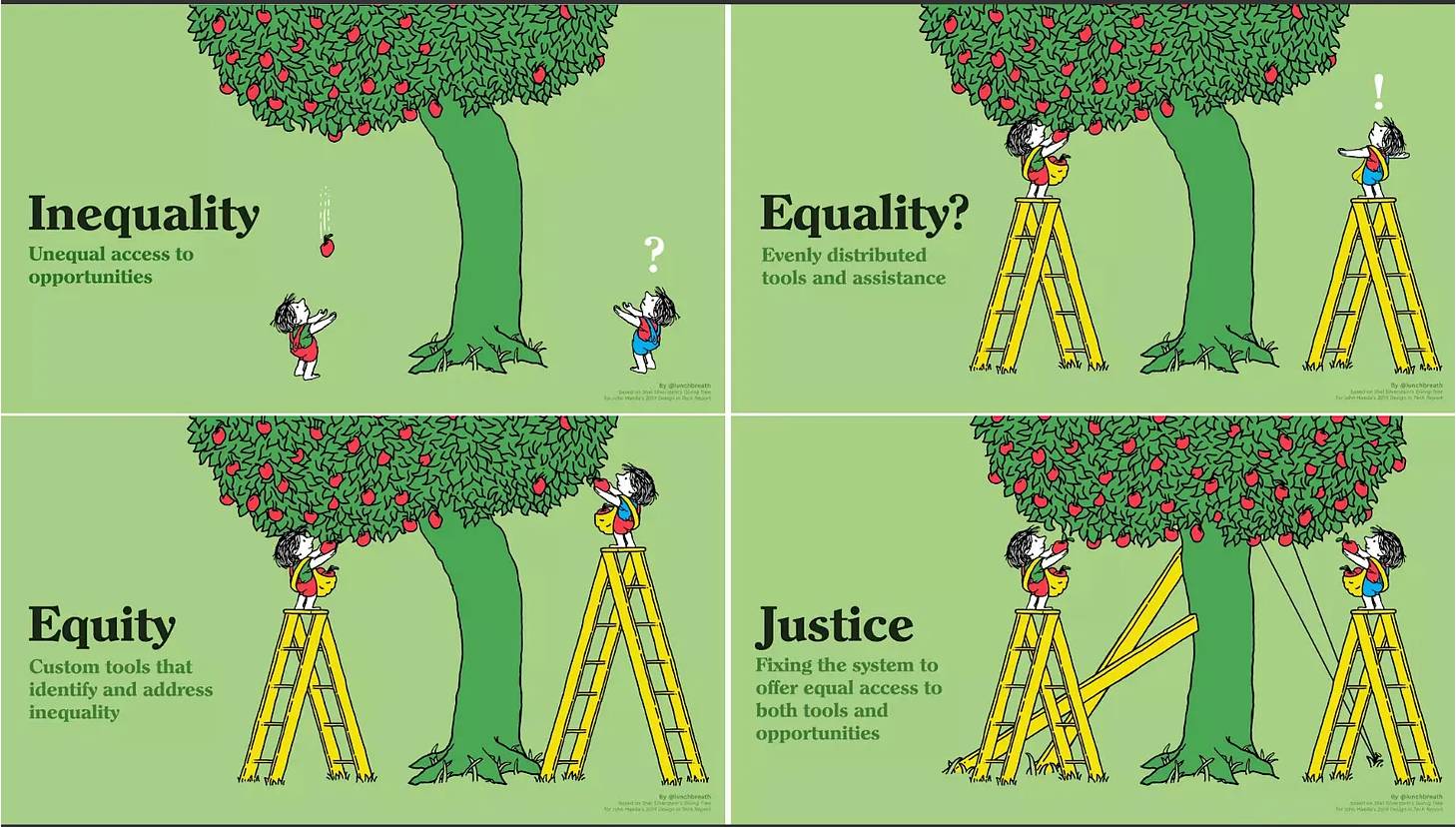
This graphic included in the Racial Justice Framework explains why Rising Sun adds “Justice” to the more common acronym “DEI”:
Impacts of Rising Sun’s investments in staff and DEIJ
Rising Sun has grown in budget and staff size since 2020, and some of the additional revenue has been invested in improvements in staff well-being. Pay levels are higher, and there are now transparent pay bands for each job title. While everyone has received raises, there have been location-based differentials, with staff in the extremely expensive Bay Area getting bigger raises than those in less costly towns in the Central Valley. A compensation survey every three years allows benchmarking against similar nonprofits, and salaries are adjusted accordingly.
Flextime and the option for some remote work have improved employees’ work-life balance. And some of the improved benefits were added specifically to reduce burnout and turnover among community-facing employees and staff of color. The mental health benefit added in response to BIPOC staff input offers six therapy sessions and six coaching sessions for all staff, including seasonal employees, as well as the youth participants in the programs. Now that federal attacks on nonprofits and on immigrants are adding stress for employees, including those with immigrant family members, four “restorative days” a year are offered, personal days that can be taken when needed. Says Rachel, “All of us leaders and supervisors have encouraged folks, ‘Hey, maybe this thing impacted one of your communities, if you need to take the day to sit with that, or to go support other people, do that, that's important.’”
Five years into the intensive DEIJ efforts, the leadership team is more racially diverse, as is the staff overall. Steven reports feeling more comfortable attending the director meetings than at his previous workplaces with all-white leadership. Another positive development is that, while previously the retirement accounts had been mostly used by white professional staff, when an employer match was increased in 2020, participation became more equitable.
The Racial Justice Framework guides both department and organizational change, such as informing a recent three-year strategic plan. The DEIJ Committee checks in with department heads twice a year about their DEIJ goals, and keeps a spreadsheet on progress. One example of a department goal is that the People and Operations Team plans to create more pathways for internal promotions; since BIPOC people are disproportionately in non-leadership positions, such pathways could reduce racial disparities in management.
Staff engagement has risen due to participation in the DEIJ Committee and in the three voluntary, unpaid groups, the BIPOC Affinity Group, a White Accountability Affinity Group, and a Solidarity Affinity Group that’s open to staff of all races.
At stressful times within the organization, the BIPOC Affinity Group has also organized staff training and self-care activities, such as workshops on financial literacy and on burnout prevention. They regularly organize cultural events, movie screenings, and activities from staff members’ cultures, such as yoga and a heritage plants garden.
Morale has risen for those participating in the BIPOC Affinity group, which Steven says is “building community intentionally with other BIPOC staff, having a shared space where we’re not just in each other’s vicinity, but intentionally building relationships—that’s been meaningful.” A staff survey respondent wrote that “the affinity groups have also become a really nice space to check in emotionally and connect on broader outside-of-work concerns in these turbulent times.”
Rachel, currently the only white person on the DEIJ Committee, says, “I've learned a lot about myself, and it's been really cool to see the folks in that group take on a different type of leadership that they might not be able to in other roles…It's been challenging but very rewarding.” As an example of something she has learned from participating in the White Accountability Affinity Group, she describes the annual employee self-evaluation process run by the HR team; previously the form required staff to write paragraphs about each aspect of their performance, but when she discovered that that was daunting for some staff who hadn’t gone to college, she converted the questions to short-answer, bullets and multiple choice.
Overall, trust and mutual respect have grown from this intensive organization-wide DEIJ effort. Steven says, “I’ve been in DEIJ spaces since my time as a student, and this committee is miles better than others I’ve experienced. We don’t treat DEIJ as a one-and-done practice. Until all the ‘isms’ in society are solved, there will always be DEIJ work to do. We treat it as ongoing practice.” Rachel agrees that long-term commitment to DEIJ is essential: “This work is not going to happen overnight, and that can feel frustrating, it can feel heavy, it can feel exhausting, but it has to be something that's built sustainably, or it won't actually stick.”
There have been surprisingly few obstacles to the DEIJ efforts. Rising Sun doesn’t get federal funding, so federal bans on DEI have not affected the organization. When this change process began in 2020, one white male staff member was uncomfortable with the DEIJ values and practices and chose to resign. The board initially asked hard questions about the budget expansions for pay raises and DEIJ spending, but they gave their support because they saw investing in staff as investing in the mission.
Takeaways for other nonprofit organizations and for funders
Nonprofits can take inspiration from how Rising Sun’s deep DEIJ work has revitalized the organization. To date, their primary focus of their DEIJ work has been on race, and on race-correlated inequities such as job rank, class, and immigration status. For other organizations, DEIJ work may also need to include gender, class, disability, age, religion, or some other dimension of structural inequities. The principles and practices of the Rising Sun success story can be applied to other ‘isms’ as well.
Transformation at this level requires supportive funders. “General operating support and multi-year grants are essential. Some changes cost little—like transparency, flexible schedules, or small professional development stipends—but others, like hiring more staff or raising salaries, require significant investment,” says Julia.
And to other nonprofits she gives this advice: “Invest in culture. Transparency is huge. Share information openly, involve staff in decisions, and trust them with the big picture. It builds morale, trust, and engagement.”
The Case Study series is the latest component of the Upgrading Nonprofit Workplaces study. Its purpose is to give examples of the practices in the Sustainable Jobs Toolkit, co-created by All Due Respect and the Staffing the Mission project, now part of Fund the People. For more best practices for DEI, see the Toolkit here.
Written by Betsy Leondar-Wright, Ph.D.
With research assistance from Nikki Mirala
Published by Fund the People
In collaboration with All Due Respect